
What is osteopathy?
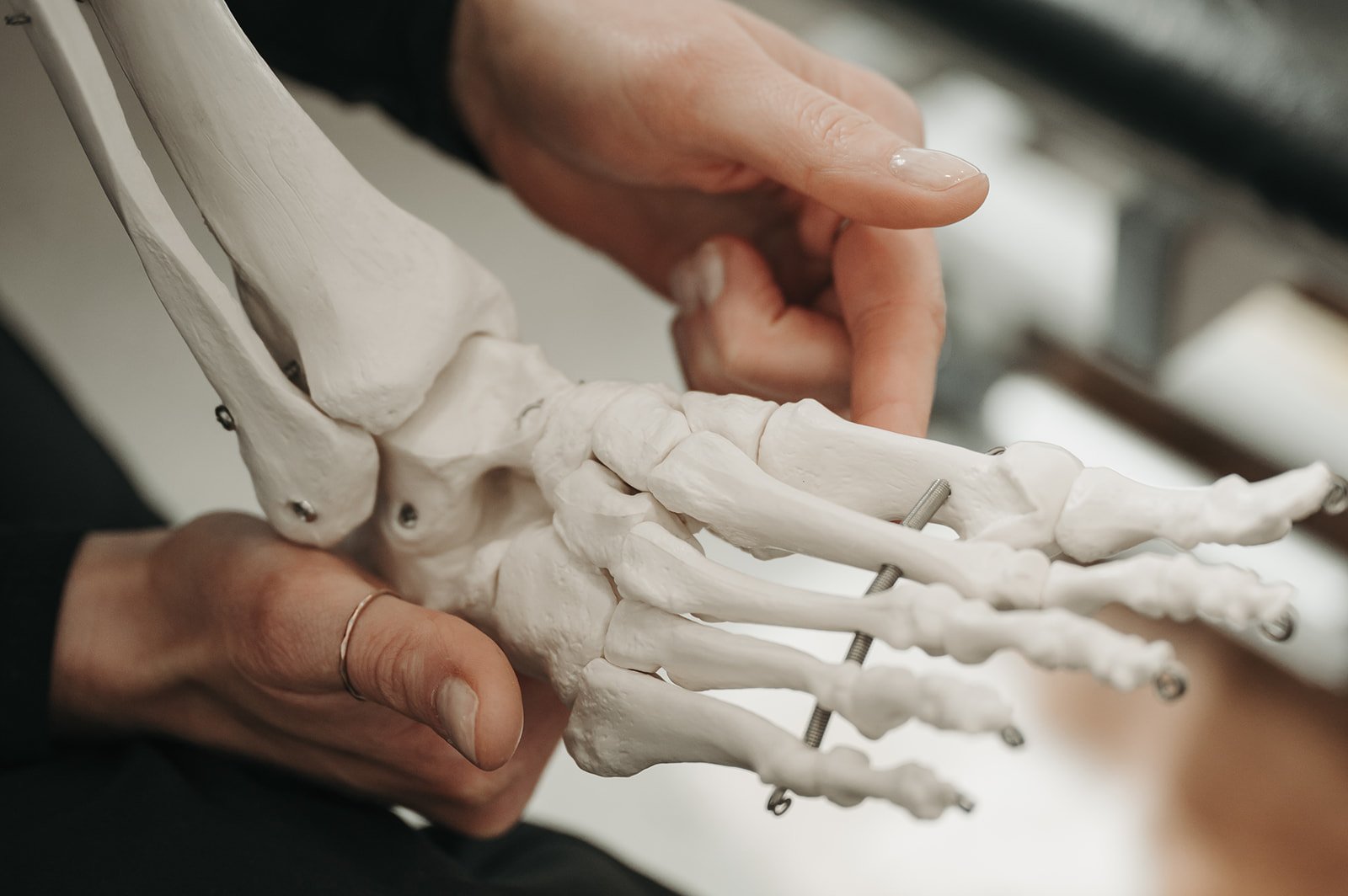
One of the first things I get asked is… so what exactly is Osteopathy?
Is it to do with bones?
Is it kind of like cranio-sacral therapy?
But what does it feel like?
And I hate to sound cliché, but Osteopathy really is something that you need to experience to start to understand. But in the meantime… Here's my best explanation of it.
Osteopathy is a manual therapy practice, similar to that of chiropractic, physiotherapy, massage therapy, and acupuncture, but our approach is more holistic in that we appreciate the body as a complex network of interconnected systems.
The tools that are available within our scope of practice range from osteoarticular adjustments (joint manipulations), muscle energy technique, soft tissue mobilization, gentle oscillations to the very subtle craniosacral approach.
Honestly, most of the time clients ask if anything is even happening.
But the power of Osteopathy comes in the subtleties of the connection between practitioner, client, and the internal healing capacity that lives within us all. In simpler terms, Osteopathy is a practice that sets the body up to heal itself from within.
It may feel like a very passive therapy. But when you shift your attention inwards, to the tone of your muscles, to the temperature of your bones, to the churning of your stomach, you’ll recognize that this power, is in fact, generated from something inside.
Osteopathy was founded in 1874 by Dr. Andrew Taylor Still, a medical physician in the United States. Osteopathy expanded across the world through Europe and Australia, and finally in Canada in 1981. Over time, Osteopathy has shifted and evolved into the two streams of practice we see today: DO, or ‘Doctor of Osteopathy’ and OMT or ‘Osteopathic Manual Therapist’. A DO identifies a medical doctor practicing in the USA, whereas an OMT is a manual therapist, as seen everywhere else in the world.
One of my instructors once said:
“An Osteopath is someone who helps to remove the barriers that are preventing that which is seeking to express itself.” (Philippe Druelle, DO)
This really speaks to the potential of Osteopathy. There are no confinements to where the barriers reside; not only physical but extend to encompass the emotional, spiritual and social being. These barriers that often manifest as physical blockages are rarely ONLY a physical problem.
For you, this may look like:
I have chronic low back pain and have been struggling with various digestive issues
I have chronic migraines and my cycle is horrendous
I work at a desk all day. My neck and upper back are constantly so tight and I often get tension headaches. Recently I’ve been having acid reflux and difficulty sleeping.
I feel like my mind is always racing and I have a hard time relaxing. Now to top it off I’m not sleeping well and often wake to see 3:00am on the clock.
I had a very
Can you start to see the complexities of Osteopathy? How boiling it down into a one sentence explanation can be challenging?
Osteopathy is defined as something like… It’s an art and a science that appreciates the complex interconnections between systems and your environment and through gentle manipulations, oscillations or adjustments, the practitioner helps to remove barriers so that the body can express optimal health.
But to truly understand the capacity of Osteopathy, I guess you’ll just have to feel it for yourself.
~ Kensey
